
Chimney Cap & Crown: Repair or Replace? How Los Angeles Homeowners Decide
Most chimney cap replacements in Los Angeles fail within two years because the real problem was the crown underneath. A chimney cap is the metal cover over your flue opening; the crown is the concrete or mortar wash that seals the top of your masonry chimney. When the crown cracks, water enters the masonry no matter how new your cap is. In our experience inspecting chimneys across Los Angeles, roughly half the homeowners who call us for a “leaky cap” actually need crown work, cap work, or both.
If you’d rather not climb your roof to figure out which is which, call us at (844) 803-1545. We’ll photograph the condition, explain what you’re looking at, and give you an upfront price before any work begins.
What a Chimney Cap Actually Does (and How It Fails)
The chimney cap sits above the flue like a small metal roof. Its job is straightforward: keep rain, animals, and debris out of the flue while letting smoke and gases escape. A good cap also blocks wind-driven downdrafts that can blow smoke back into your living room.
Caps fail in three predictable ways in Los Angeles:
- Wind damage: Santa Ana gusts can bend or detach poorly secured caps, especially on older installations with corroded fasteners.
- Rust and corrosion: Our marine layer and occasional salt air accelerate rust on galvanized steel caps. Stainless steel and copper caps last longer but cost more upfront.
- Animal intrusion: Squirrels and raccoons in the Hollywood Hills and Pasadena foothills can pry off lightweight caps to nest in the flue.
When a cap fails, the symptoms are obvious: water in the firebox, debris falling down the flue, or animal sounds from above the damper. The fix is usually straightforward, replace the cap with a properly sized unit secured with stainless steel fasteners. A quality cap from Gelco or Olympia Chimney, properly installed, should last 15 to 20 years in our climate.
But here’s where homeowners get stuck. They replace the cap, the leak stops for a season, and then it returns. The cap was never the real problem.
What a Chimney Crown Actually Does (and Why It’s More Critical)
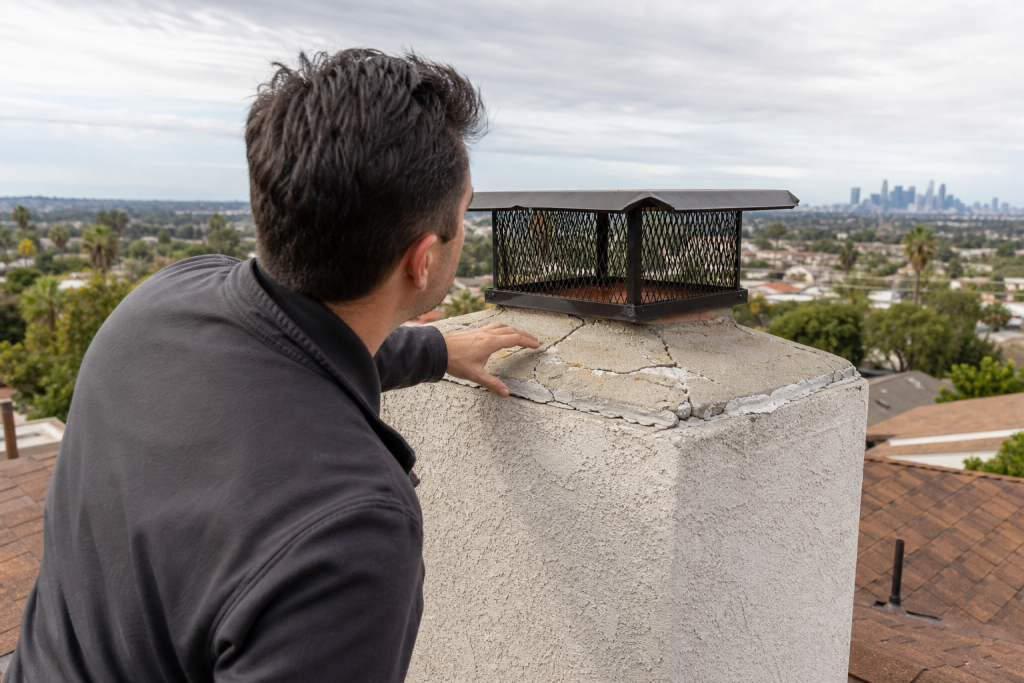
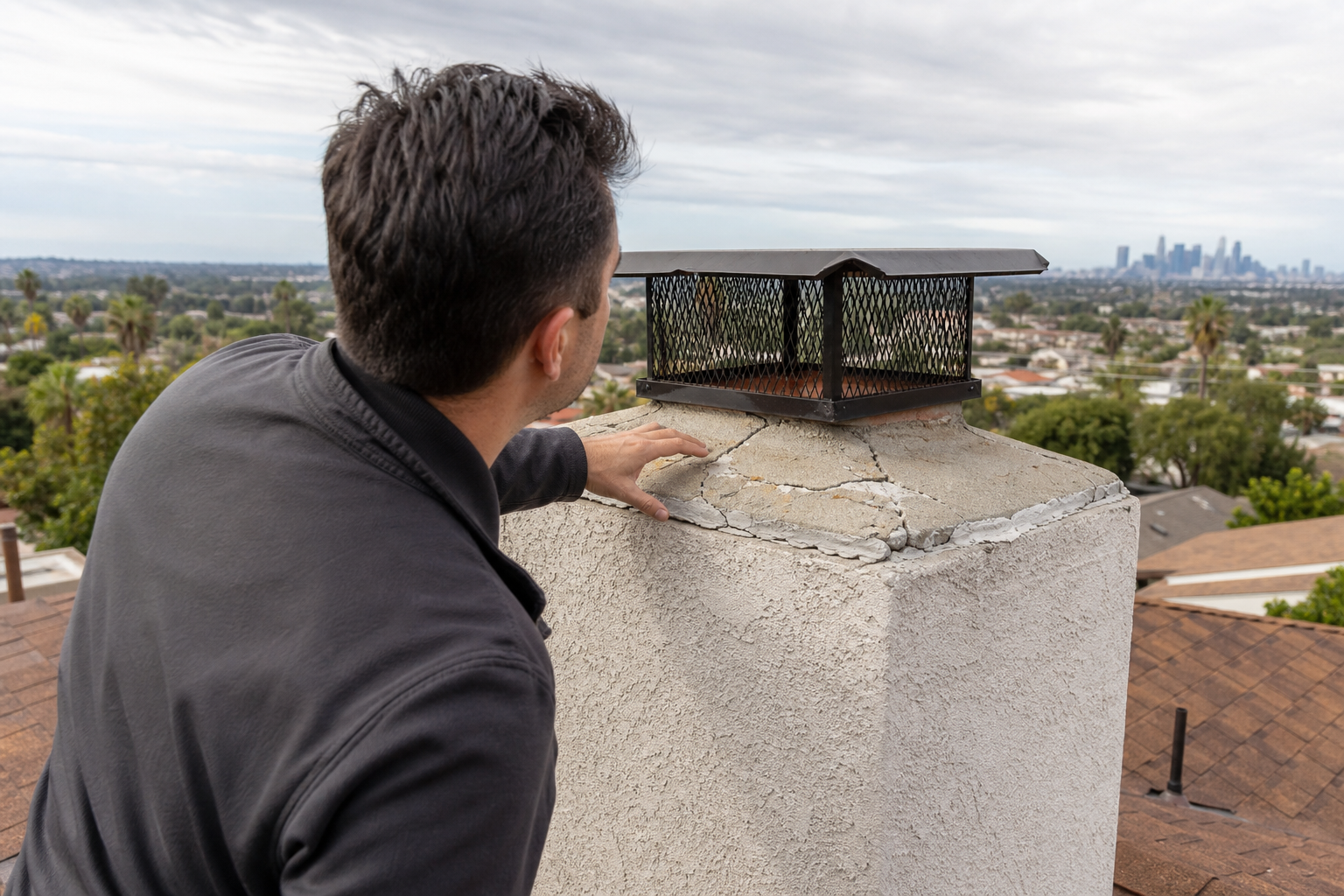
The chimney crown is the concrete or mortar slab that covers the top of your masonry chimney, sealing the space between the outer brick and the flue tile. Unlike the cap, which is replaceable and relatively inexpensive, the crown is structural. When it fails, water enters the masonry itself, causing brick spalling, mortar deterioration, and eventually costly rebuilds.
The crown’s design matters enormously. A properly built crown has a slight slope to shed water, an overhang that drips clear of the brick below (called a “drip edge”), and is made from proper concrete mix, not leftover mortar. Many Los Angeles chimneys built in the 1960s through 1980s were finished with a “wash,” a thin layer of mortar that cracks within a decade.
Crown failures in Los Angeles follow a specific pattern. Our climate doesn’t have the freeze-thaw cycles that destroy crowns in Chicago or Denver. Instead, our damage comes from:
- Thermal cycling: Summer rooftop temperatures exceed 150°F, then drop sharply after sunset. The concrete expands and contracts daily, stressing the crown.
- UV degradation: Direct sun breaks down the surface cement paste, causing hairline cracks that widen each season.
- Earthquake micro-movement: Minor seismic shifts stress the bond between crown and flue tile.
Because our winters are mild, water enters these cracks year-round instead of freezing and making itself known. By the time a Los Angeles homeowner notices a crown leak, the damage is often extensive. We inspected a chimney in Los Feliz last month where the crown had been cracked for six years. The homeowner assumed the dark stains on the ceiling were from an old roof leak. The brick face was actually separating from the structure.
Repair or Replace? The Decision Framework for Each Component
Chimney Cap: Usually Replace, Rarely Repair
Caps are replaceable components. If the mesh is rusted through, the lid is bent, or the fasteners have pulled out, replacement is almost always more cost-effective than repair. The exception: a high-quality stainless steel or copper cap with a damaged mounting bracket, which a competent sweep can sometimes re-secure.
When evaluating a cap replacement bid, insist on:
- Photos of the existing cap and flue opening
- Specified material (galvanized, stainless steel, or copper) and gauge
- Confirmation that the new cap is sized to your flue count and diameter
- A stated warranty period (typically 5 to 10 years for quality materials)
Chimney Crown: Seal, Resurface, or Rebuild
The crown decision tree has three branches:
Seal: For hairline cracks with no spalling or separation. We use a professional-grade elastomeric sealant, HeatShield CrownSeal or equivalent, that remains flexible and UV-stable. This is a 3- to 5-year solution, not permanent, but appropriate for crowns that are fundamentally sound.
Resurface: For moderate cracking with minor surface degradation. The existing crown is cleaned, primed, and coated with a 1/4-inch layer of specialized resurfacing material. This extends service life 10 to 15 years if the underlying concrete is solid.
Rebuild: For crowns with through-cracks, spalling, separation from the flue tile, or structural movement. The old crown is removed to the top course of brick, and a new crown is poured with proper concrete mix, reinforcement, slope, and drip edge. This is the only permanent solution for failed crowns.
The key point: sealing or resurfacing a crown that needs rebuilding wastes money. We’ve seen this mistake repeatedly in Los Angeles neighborhoods like Silver Lake and Echo Park, where previous owners applied caulk or roofing tar to crowns that were structurally compromised. The water kept entering, silently, until the chimney needed a partial rebuild.
How LA’s Climate Hides Crown Problems (Until It’s Expensive)
In colder climates, a cracked crown announces itself dramatically. Water enters in fall, freezes in winter, expands, and blows off chunks of concrete. Homeowners see the damage and call for repairs.
Los Angeles offers no such warning system. Water enters through crown cracks in January just as easily as June, and it simply drains through the masonry, carrying dissolved salts that effloresce on interior surfaces or stain ceilings. The damage accumulates invisibly.
This is why we recommend annual chimney inspections in Los Angeles, even for chimneys that appear fine from the ground. Our Level-2 camera inspections include rooftop photos of the crown condition that you can see yourself, with a plain-English verdict on whether seal, resurface, or rebuild is appropriate.
We’ve documented crown cracks in Pasadena chimneys that looked pristine from the street. The homeowners had no indication of trouble until we showed them the photos.
Reading a Quote: What a Legitimate Bid Includes
Whether you choose Chimney Repair in Los Angeles from Hearthstone or another qualified company, a legitimate cap or crown bid should contain specific elements. Vague proposals lead to disputes.
Demand these in writing:
- Photos of the existing condition - not stock images, your actual chimney
- Material specifications - for caps: metal type, gauge, mesh size; for crowns: concrete mix type, reinforcement method, slope and overhang dimensions
- Scope of work - seal, resurface, or rebuild; partial or full crown; flue tile inspection included or separate
- Warranty period and terms - what is covered, what voids it, how claims are handled
- Total price with no open-ended allowances - the number on the estimate should match the number on the invoice
At Hearthstone, our bids include all five elements as standard practice. Our 90-Day Done Right Promise covers the work in writing with no arguing - if it’s not right, we come back. We’ve operated this way for over 42 years because it’s the only way that makes sense for a company that plans to be in Los Angeles for thirty more.
Be wary of bids that seem to solve both cap and crown problems with a single product. A “crown/cap combo” unit may address minor crown issues, but it cannot rebuild structural failure. And never accept a crown repair that doesn’t include inspecting the flue tile beneath it - a cracked flue tile with a new crown is a fire hazard waiting to happen.
What happens when you call
- 1
A real person answersNo phone trees - you reach a local pro.
- 2
You get an upfront price rangeHonest numbers before anyone is dispatched.
- 3
A background-checked tech heads outLicensed & insured, dispatched right away.
- 4
You approve before work beginsNothing starts until you say go.
When to Call a Professional
If you can safely access your roof with binoculars, check for these visible signs: rust streaks running down the chimney face (cap failure), visible cracks or missing chunks on the crown surface, or a cap that sits crooked or loose. If you see any of these, or if you’ve noticed water in the firebox, ceiling stains near the chimney, or a musty smell when you open the damper, it’s time for a professional inspection.
Do not attempt crown repairs yourself. The work requires proper concrete placement at height, and the consequences of a failed repair include water damage to your home’s structure and potential fire hazards from compromised flue integrity. This is skilled trade work, not a weekend project.
Related services in Los Angeles: Fireplace Services in Los Angeles for damper, firebox, and insert concerns; Chimney Repair in Los Angeles for masonry, liner, and structural issues.
Key Takeaways
- The chimney cap and crown are separate components with separate failure modes - conflating them leads to paying twice for the same leak
- Caps typically need replacement; crowns may be sealed, resurfaced, or rebuilt depending on damage severity
- Los Angeles’s mild climate hides crown damage until it’s extensive - annual inspection with photos is essential
- Legitimate bids include photos, material specs, scope, warranty, and firm pricing
- Never seal or resurface a crown that has through-cracks or structural movement
The Bottom Line
The cap keeps debris and animals out. The crown keeps water out of your masonry. Replacing one when the other has failed is how homeowners in Los Angeles end up with recurring leaks, stained ceilings, and eventually four-figure rebuilds.
Get the diagnosis right first. That means a rooftop inspection with photos you can see, a plain-English explanation of what you’re looking at, and an upfront price for the appropriate fix. Done right, a cap replacement and crown repair should solve your water problem for a decade or more. Done wrong, you’ll be calling someone again next season.
If you’re in Los Angeles and want a second opinion on a chimney cap or crown issue, Hearthstone Chimney Co. offers free estimates. We’ll photograph the condition, explain your options without pressure, and give you a written price before any work begins. Call (844) 803-1545 - a live person answers, 24 hours a day.
Frequently Asked Questions
Chimney cap replacement in Los Angeles typically ranges from $250 to $650 installed, depending on flue count, material, and access difficulty. Single-flue galvanized caps fall at the lower end; multi-flue stainless steel or copper caps with custom mounting run higher. Call (844) 803-1545 for an exact quote on your chimney - estimates are free.
Crown sealing runs $400 to $800, resurfacing $900 to $1,800, and full crown rebuilds $2,200 to $4,500 in the Los Angeles market. The wide range reflects crown size, accessibility, and whether flue tile repair is needed underneath. We recommend getting photos and a written scope before comparing bids. Call (844) 803-1545 for a free estimate with documented condition.
Sealing or resurfacing costs less upfront than rebuilding, but only if the underlying concrete is sound. Applying sealant to a structurally failed crown wastes money and delays the inevitable rebuild while water continues damaging your masonry. A proper inspection determines which approach is actually economical long-term. We provide that inspection with photos at no charge - call (844) 803-1545.
Crown sealing can often be completed in a single visit if the chimney is accessible and the crown is clean and dry. Resurfacing and rebuilds require specific weather conditions and cure times, so same-day completion is less common. Our background-checked, uniformed technicians complete most jobs in a single visit when conditions allow. Call (844) 803-1545 to schedule - a live person answers 24/7.
Written by the team at Hearthstone Chimney Co., serving Los Angeles since 2014.
Need Chimney Cleaning Help?
Call Hearthstone Chimney Co. - licensed & insured, here with fast after-hours help in Los Angeles.
(844) 803-1545