
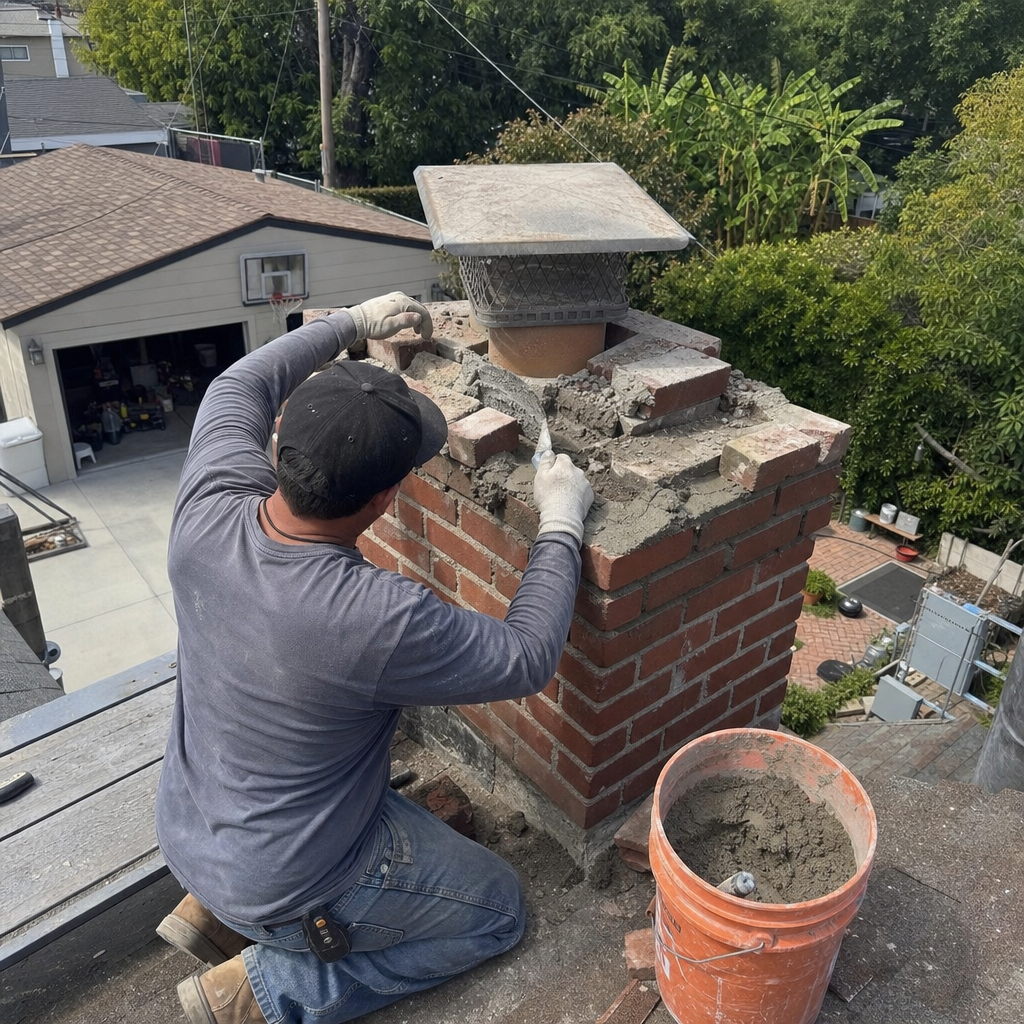
Creosote Removal in Los Angeles, CA
Creosote removal in Los Angeles typically costs between $150 and $600 depending on the degree of buildup, and most jobs are completed in a single visit. It’s the one Chimney Cleaning & Sweep services where skipping it doesn’t just mean a dirty flue – it means a documented fire hazard inside your home. Hearthstone Chimney Co. has been removing creosote from Los Angeles chimneys since 1984, and we’ve handled everything from light first-degree brushwork in Silver Lake bungalows to third-degree glaze removal in older Pasadena homes that hadn’t been touched in decades.
If you’re using your fireplace regularly – or even occasionally – creosote accumulates whether you see it or not. It’s a natural byproduct of burning wood, and Southern California’s mild winters create a specific pattern we see often: homeowners burn a handful of fires in December and January, don’t sweep for two or three seasons, and by the time they call us, the flue has a heavier buildup than they expected. That’s not a judgment. It’s just what happens when the fireplace isn’t the primary heat source and Fireplace Cleaning and maintenance falls off the to-do list.
Our Chimney Cleaning & Sweep in Los Angeles service covers everything from routine annual sweeping to full creosote remediation, and this page focuses specifically on what removal involves, what it costs, and how you know when it’s overdue. Questions before you read? Call us directly at (844) 803-1545. A live person picks up every call, every day.
What Creosote Is and Why It Matters
Creosote forms when wood smoke rises through a flue that’s cooler than the fire below. As the smoke cools, unburned particles condense on the inner walls of the liner. Over time, these deposits build up in layers – and each layer is more dangerous than the last.
Chimney professionals classify creosote in three degrees, and that classification drives everything: the method we use, the time it takes, and the cost.
- First-degree creosote is a light, dusty or flaky deposit. It brushes off cleanly with standard sweep tools and is the easiest to address.
- Second-degree creosote is harder and tar-like, often appearing shiny or crunchy in texture. It requires more aggressive brushing and sometimes chemical treatment to fully break up.
- Third-degree creosote – also called glazed creosote – is the most serious. It’s a concentrated, hardened coating that standard brushing cannot remove. It has an ignition point around 451 degrees Fahrenheit, and once it catches, a chimney fire can exceed 2,000 degrees inside the flue. This degree requires specialized chemical treatments and, in many cases, a follow-up visit after the chemical has had time to work.
In Los Angeles, third-degree buildup turns up more often than you’d expect. Older homes in neighborhoods like Highland Park, Eagle Rock, and Mid-City sometimes have fireplaces that were used heavily in the 1970s and 80s and then gradually abandoned as central heat became standard. When those homeowners decide to relight the fireplace – or when a new owner moves in – they’re sometimes looking at years of untouched glazed creosote. We’ve seen it. We know how to handle it.
It’s also worth understanding that creosote buildup is accelerated by burning unseasoned wood, running low, smoldering fires, and cold flues. In Los Angeles, where overnight temperatures rarely force the flue to full operating temperature, cool-running fires are common – which means creosote forms faster here than it does in colder climates where fires burn hotter and longer.
When You Need Creosote Removal
Some of these signs are obvious. Some aren’t. Here’s what we tell homeowners to watch for:
- A strong, oily or tar-like smell from the fireplace – especially noticeable on warm days or when the weather shifts. In the San Fernando Valley, where summer afternoons can push 100 degrees, a creosote odor baking out of the chimney is a reliable sign of significant buildup.
- Visible black or brown deposits inside the firebox – if you can see dark, shiny, or tar-like material on the damper or the first few feet of the flue, what’s further up is likely worse.
- You haven’t had the chimney swept in more than a year – the National Fire Protection Association standard is once per year for any actively used fireplace. In Los Angeles, where fires tend to be shorter and cooler, we often see significant buildup after just one season.
- The fireplace smokes back into the room – a partially blocked flue from creosote accumulation can disrupt draft and push smoke into the living space.
- You’ve had a chimney fire – even a minor one. Chimney fires often go unnoticed by homeowners, producing only a low rumbling sound and some cracking. But they can turn second-degree creosote into hardened third-degree glaze, and they can crack the liner. After any suspected chimney fire, the flue needs a Level 2 inspection before the fireplace is used again.
- You’re purchasing a home with a fireplace – this is standard pre-occupancy due diligence. In older Los Angeles neighborhoods like Leimert Park or Los Feliz, fireplace histories are often unknown. Don’t assume the previous owners maintained it.
Our Creosote Removal Process
We don’t use a one-size approach here. What we do depends on what we find, and we don’t know what we’ll find until we look. That’s why every creosote removal job starts with a Level 1 Inspection – not a quick glance up the flue with a flashlight.
- Level 2 camera inspection first. We run a video camera through the full length of the flue from crown to firebox. You see what we see – on a screen, in real time – and when we’re done, you get a written report with photos and a plain-English verdict. No guesswork. No vague statements about “some buildup.” If there’s third-degree glaze, we’ll show it to you.
- Degree classification and job scoping. Based on the inspection, we tell you exactly which degree of creosote you have, what removal method it requires, and what it will cost. The estimate you get before we start work is the number on the invoice when we finish. No-hassle upfront pricing means no surprises.
- Protective setup inside your home. Our uniformed technicians lay down drop cloths and seal the firebox opening before any brushing or treatment begins. A creosote removal job in a Brentwood living room should not leave soot on the furniture. Ours doesn’t.
- Mechanical removal with professional-grade tools. For first- and second-degree deposits, we use rotary and manual chimney brushes sized to your specific flue dimensions. For heavier second-degree buildup, we use chemical treatments – including products from trusted suppliers like Gelco – to break up stubborn tar-like deposits before brushing.
- Chemical treatment for third-degree glaze. Glazed creosote requires a two-stage approach. We apply a chemical agent that converts the glaze into a more porous, removable material, then return – sometimes on a follow-up visit – to brush it clean. We’ll tell you upfront if your job requires two visits. We don’t pretend a single sweep solved a problem that needs two appointments.
- Post-removal inspection and documentation. After removal, we camera-inspect again. If the liner sustained heat damage from past chimney fires, we’ll document it and walk you through your repair options – including liner restoration using HeatShield ceramic resurfacer when appropriate. You leave with photos, a written report, and a clear picture of where things stand.
Creosote Removal Pricing in Los Angeles
Creosote removal in Los Angeles ranges from about $150 to $600 or more for standard residential jobs. Third-degree glaze removal requiring chemical treatment and multiple visits can run higher. Here’s how the pricing typically breaks down by degree:
| Creosote Degree | Typical Price Range | Notes |
|---|---|---|
| First-degree (light, flaky) | $150 – $250 | Usually included in standard sweep; minimal extra time |
| Second-degree (tar-like, shiny) | $250 – $400 | May require chemical treatment; single visit in most cases |
| Third-degree (glazed, hardened) | $400 – $600+ | Chemical treatment required; may need follow-up visit |
| Level 2 camera inspection (included) | Included with job | Pre- and post-removal; photos and written report |
A few things affect where your job lands in that range. Flue height and configuration matter – a two-story Craftsman in Pasadena has a longer flue run than a single-story ranch in Northridge, and more flue means more time. The number of fireplaces and flues in the home matters. And whether any liner damage is discovered during inspection will affect whether repair work is recommended separately from the cleaning.
If you’ve already gotten a written estimate from another company and something about it doesn’t sit right, our Free Second Opinion offer is available at no charge. Bring the estimate. We’ll look at the chimney and tell you plainly what we see.
For any repair that comes out of a creosote removal job and totals over $250, our $50 Off Any Repair Over $250 discount applies. We also offer a permanent 5% discount for seniors and veterans. These are standing offers – not promotions with expiration dates.
Call (844) 803-1545 for a free estimate. The number we give you before we start is the number on the invoice when we finish.
Why Los Angeles Chimneys Build Creosote Faster Than You’d Expect
This is something we explain regularly, because most Los Angeles homeowners assume their mild climate means less chimney maintenance – not more. The logic makes sense on the surface. But here’s what actually happens.
In a cold-climate city, homeowners run long, hot fires through a full winter. Those fires fully warm the flue, and a hot flue produces less condensation, which means slower creosote accumulation per fire. In Los Angeles, fires tend to be shorter – an hour or two on a cool evening – and the flue never fully reaches operating temperature before the fire dies down. That cool flue is exactly the condition that promotes creosote condensation. You end up with heavier deposits per fire than you’d see in a house in Denver burning the same amount of wood.
Add in the fact that many Los Angeles homeowners burn whatever wood they can find – sometimes green or partially seasoned eucalyptus, which is common here and produces significantly more creosote than dry hardwood – and you have a market where we routinely find heavier buildup than homeowners anticipate.
We also see the effects of deferred maintenance in communities throughout the city. In neighborhoods like Encino, Sherman Oaks, and Studio City, we regularly work on homes where the fireplace was used for twenty or thirty years with minimal professional maintenance. The chimneys in those homes often show multi-year accumulation – sometimes multiple degrees of creosote layered on top of each other.
The 90-Day Done Right Promise
Every creosote removal job we complete is backed by our 90-Day Done Right Promise. If something is not right, we come back and make it right. In writing. No paperwork, no arguing, no waiting to see if we’ll honor it. This is part of what we call the K.E.Y.S. values code – Krafted right, Every time, Your home first, Standing behind it – and it governs how every job is done, not just the ones that are easy.
We’ve been in Los Angeles since 2014. A company that plans to be answering the phone here for another forty years doesn’t cut corners on a creosote job. The math doesn’t work any other way.
FAQs – Creosote Removal
How much does creosote removal cost in Los Angeles?
Creosote removal in Los Angeles typically runs $150 to $600 for residential chimneys, depending on the degree of buildup. First-degree removal is usually covered within a standard sweep at the lower end of that range. Third-degree glazed creosote, which requires chemical treatment and sometimes two visits, sits at the higher end. Your estimate from Hearthstone Chimney Co. is fixed – the number we give you before we start is the number on the invoice. Call (844) 803-1545 for a free estimate before committing to anything.
Is creosote removal something a homeowner can do safely themselves?
Light, first-degree creosote can technically be brushed by a homeowner with the right tools, but third-degree glazed creosote cannot be safely addressed without professional chemical treatment – and even identifying which degree you have requires a proper inspection. More practically: without a camera inspection, you won’t know if the liner has cracks that make the chimney unsafe to use regardless of how clean the flue is. The inspection is where the real value sits, and it requires professional equipment. We document everything with photos you can see, so you’re not just taking our word for it.
How often should Los Angeles homeowners have creosote removed?
Once per year is the NFPA standard for any actively used fireplace, and that holds for How Often Should You Clean your Chimney? (Los Angeles, CA). Given the tendency for shorter, cooler fires and the prevalence of partially seasoned wood in Southern California, annual sweeping and inspection is the right baseline. Homeowners who burn more than two or three cords of wood per season should consider twice-yearly service. If you’ve skipped a year – or several – the only honest answer is to have an inspection first and go from there.
What happens if creosote is not removed?
Creosote left in place continues to accumulate and harden through the degree stages. Third-degree glaze has an ignition point low enough that a routine fire can trigger a chimney fire – one that can crack the liner, ignite structural framing, and spread to the living area before a homeowner realizes what’s happening. Beyond fire risk, heavy creosote buildup restricts draft, causes smoke to back into the home, and produces a persistent odor during warm weather – a complaint we hear often from homeowners in the San Fernando Valley during summer. Removal is not a discretionary maintenance item. Call (844) 803-1545 if you’re not sure where your chimney stands.
Schedule Your Creosote Inspection Today
If you’re not sure when the chimney was last swept, or you’ve noticed any of the signs described on this page, a Level 2 camera inspection is the right starting point. We’ll tell you exactly what’s in the flue, show you photos, and give you a written estimate before any work begins. Most jobs are done in a single visit. All work is covered by the 90-Day Done Right Promise in writing.
Hearthstone Chimney Co. has been serving Los Angeles homeowners since 2014. Call (844) 803-1545 any time – a live person answers every call, around the clock. The estimate is free. The pricing is upfront. The work is backed. That’s the standard we’ve held for over 12 years, and it’s the one we’ll hold on your job.
Written by the team at Hearthstone Chimney Co., serving Los Angeles.