
Carbon Monoxide Alarm Going Off Near the Fireplace
If your carbon monoxide alarm is sounding near the fireplace, treat it as a real emergency. Get everyone – including pets – out of the house immediately, leave the door open as you go, and call 911 before you call anyone else. Do not go back inside until emergency responders clear the air and tell you it is safe.
What’s Happening
A carbon monoxide alarm near your fireplace is almost always telling you that combustion gases – gases that should be traveling up and out through your chimney – are spilling back into your living space instead. The most common cause is a blocked or restricted flue. That blockage could be creosote buildup, a collapsed liner, a plugged damper, or an animal nest sitting somewhere in the chimney stack.
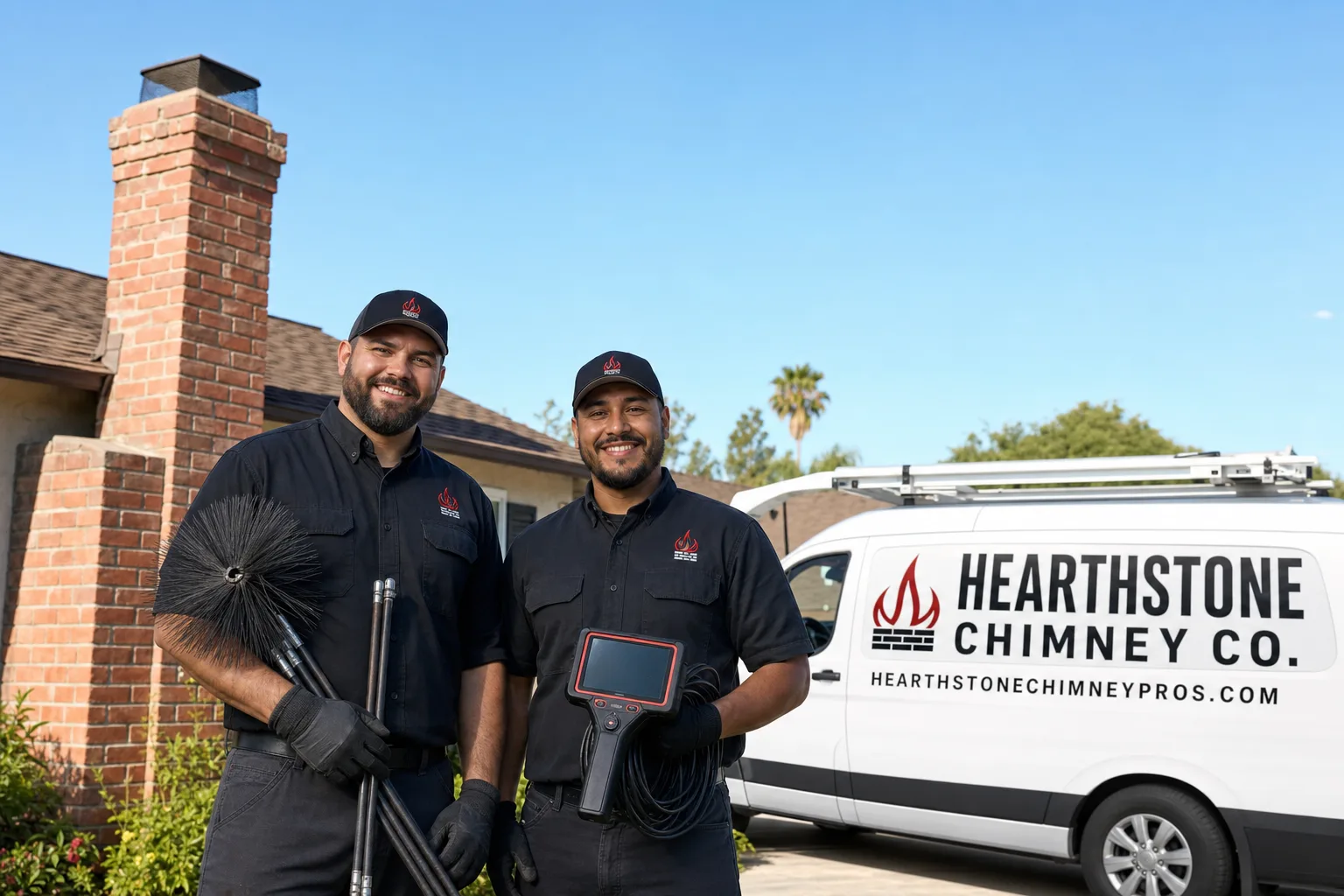
Carbon monoxide is colorless and odorless, which is exactly why your alarm exists. When the flue can’t exhaust properly, CO produced by a fire (or even by a gas appliance vented through the same chimney) builds up in the room. Your alarm is doing its job. The chimney is not doing its job – and that gap between the two is what your local Hearthstone Chimney Co. team is trained to close. A level-2 camera inspection will find the source, document it with photos you can look at yourself, and give you a plain-English answer before any work begins.
Why It Happens
1. Heavy Creosote Buildup in the Flue
After years of fires, creosote – a tarry, carbon-rich residue – accumulates on the inner walls of your flue. Enough of it and the usable opening narrows to the point where exhaust gases can’t rise fast enough to clear the firebox. You may notice a sharp, asphalt-like smell even when the fireplace isn’t in use, or see a dark, sticky residue just inside the firebox opening. This is the single most common reason a CO alarm trips near a fireplace, and it is entirely preventable with routine chimney cleaning.
2. A Blocked Damper or Stuck-Closed Damper
The damper is the metal plate sitting just above the firebox that opens to allow smoke and gases to escape. Dampers corrode, warp from heat cycles, and collect debris. If yours is stuck partially or fully closed, combustion gases have nowhere to go but back into the room. You can often see the damper from inside the firebox with a flashlight – if it looks heavily rusted, won’t move when you pull the handle, or has visible debris packed around it, that is your likely culprit.
3. Animal Nests or Debris Blocking the Flue
Squirrels, birds, and raccoons find chimney flues to be perfectly sheltered nesting spots, particularly in spring. A nest packed into the upper flue creates an effective plug that can redirect exhaust back down into the house. If you hear scratching or chirping sounds near the firebox, or if you can see sticks and leaves falling into the firebox itself, an obstruction is the likely cause. Do not attempt to reach up into the flue – leave the inspection and removal to a trained technician.
4. A Cracked or Collapsed Flue Liner
Clay tile liners crack from thermal shock – the rapid heating and cooling that happens every time you light a fire. When a tile fractures or collapses, gaps open in the liner that allow CO and other combustion gases to seep sideways into the surrounding masonry and, from there, into the living space. This one is harder to diagnose from the outside because the damage is usually several feet up inside the flue. A level-2 camera inspection is the only reliable way to find it – which is exactly the kind of documentation your local Hearthstone Chimney Co. team provides.
What to Do Right Now
- Get out first. If the alarm is active, do not investigate – leave the house with everyone in it, leave a door open behind you, and call 911. Let the fire department confirm the air is safe before re-entering.
- Stop using the fireplace. Even after the alarm clears, do not light another fire until a technician has identified and corrected the source. Using a venting-compromised fireplace risks a second, potentially more severe CO event.
- Do not open the flue and assume the problem is solved. If the damper was closed, opening it may reduce the immediate reading – but it does not fix whatever caused the restriction in the first place.
- Photograph what you can safely see. Standing well back from the firebox, take a photo of the firebox opening, the damper handle position, and any visible debris or staining. These photos help your technician understand what they are walking into.
- Note when the alarm started and what was running. Was the fireplace in use? A gas appliance? The furnace? CO can come from more than one source, and the timeline matters to the technician.
How We Fix It
When your local Hearthstone Chimney Co. team arrives, the first step is always a level-2 camera inspection. A certified technician runs a camera the full length of the flue, photographs what’s there, and gives you a plain-English verdict on exactly what is causing the restriction or breach. You see the photos. You know the answer before anything is touched.
From there, the repair path depends on what the camera finds. A creosote-blocked flue calls for a professional chimney cleaning and sweep. A cracked or deteriorated liner calls for a chimney liner replacement, installed with DuraFlex or HeatShield materials – no builder-grade substitutes. A failed damper may be addressed as part of a broader fireplace service visit.
Most jobs are completed in a single visit. Before any work begins, you receive a written estimate – the number on that estimate is the number on the invoice, no adjustments added at the end. Every repair is backed by the 90-Day Done Right Promise: if it’s not right, we come back, in writing, no arguing.
Frequently Asked Questions
Treat it as real until proven otherwise – carbon monoxide at elevated levels can cause serious harm within minutes, and the alarm exists precisely because you cannot detect CO on your own. False alarms do happen, typically from a sensor that has reached the end of its service life, but you have no way to know which situation you are in while standing in the room. Get out, call 911, and let the fire department take a reading. Once the air is cleared, call (844) 803-1545 so we can find the source and make sure it cannot happen again.
It needs to be looked at before you use the fireplace again – full stop. The risk is not theoretical: a blocked or breached flue on an active fireplace is a CO hazard every time it is used. Call (844) 803-1545 and your local Hearthstone Chimney Co. team will get someone out to you. A live person answers every call, every hour of every day.
Call us at (844) 803-1545 and we will tell you exactly what is available in your area. Phones are staffed by a live person 24 hours a day, 7 days a week – not a voicemail, not a callback queue. We understand that “carbon monoxide alarm” and “can it wait” do not belong in the same sentence.
The honest answer is that the cost depends on what the camera inspection finds – and that is not a dodge, it is just true. A chimney cleaning runs differently from a liner replacement, and we will not guess at your situation before we see it. What we will do is give you a written estimate before a single dollar of work begins, and the number on that estimate is the number on the invoice. Call (844) 803-1545 or book online to get a free written estimate for your specific job.
Get It Fixed
Call (844) 803-1545 right now – a live person will answer. Your local Hearthstone Chimney Co. team will schedule an inspection, document what the camera finds, and give you a written estimate before any work starts. The fireplace stays closed until it is safe. That is the only square deal.
Written by Russell Haines, Owner and Master Sweep at Hearthstone Chimney Co., serving local communities since 1984.