
What’s Happening
Creosote buildup in your chimney is almost always the result of incomplete combustion – wood gases that cooled and condensed on the flue walls before they could escape. It’s flammable, it restricts airflow, and the more of it that accumulates, the closer you are to a chimney fire. If you’re seeing black, tar-like residue around your firebox opening, smelling something sharp or smoky when the fireplace isn’t in use, or noticing your fires don’t draft the way they used to, you’re looking at a creosote problem.
Creosote comes in three stages, and the difference matters. Stage one is a dry, flaky soot that a sweep can brush out in a standard cleaning visit. Stage two is a harder, crunchy coating – still removable, but it takes the right tools. Stage three is a dense, tar-like glaze that has soaked into the flue tile and, in serious cases, can only be resolved with a chemical treatment like HeatShield or a full liner replacement. Knowing which stage you’re dealing with changes everything about how you approach it – and that’s exactly what a Level-2 camera inspection is for.
Why It Happens
Burning Wet or Unseasoned Wood
Green wood contains a high percentage of water. When it burns, that moisture cools the combustion gases before they reach the flue, and the unburned byproducts condense on the liner walls as creosote. You can often tell this is the cause if your fires produce a lot of dark, heavy smoke and the wood hisses or steams at the ends rather than burning cleanly. The fix starts in the woodpile, but the damage already inside the chimney still needs to come out.
Low, Smoldering Fires
A fire that’s banked down too low – damper barely cracked, airflow restricted – burns cool and produces a thick stream of partially combusted gases. Those gases don’t move fast enough to exit the flue before cooling, so they stick. If you tend to run small fires for hours at a time rather than hotter, shorter burns, this is the likely culprit. The residue from slow burns tends to be stickier and darker than what you’d see from a single hot fire.
A Flue That’s the Wrong Size for the Fireplace
An oversized flue relative to the firebox opening allows combustion gases to slow down and cool before they exit – exactly the conditions creosote needs. An undersized flue creates back-pressure. Either way, the draft suffers and buildup accelerates. You can suspect a sizing mismatch if your drafting problems started when you changed fireplace inserts, added a stove, or had other flue work done. A Level-2 inspection will show the liner diameter and whether it’s matched correctly to your appliance.
A Damaged or Deteriorating Flue Liner
Cracked, spalled, or missing liner sections create ledges where creosote clings and accumulates faster than on a smooth surface. They also allow combustion gases to seep into the surrounding masonry, which is a separate safety problem on top of the buildup issue. From inside the home, you may notice staining on the exterior of the chimney breast, a persistent smoky smell in rooms near the chimney, or visible cracks at the firebox throat. This one requires a camera to confirm – there’s no safe way to assess liner condition from the firebox opening alone.
What to Do Right Now
- Stop using the fireplace. A creosote-coated flue is a fire hazard. If you have any reason to believe you’re past stage one buildup – heavy deposits, tar-like residue, a strong acrid smell – don’t light another fire until a sweep has assessed it. This isn’t being overly cautious; it’s the right call.
- Photograph what you can see. From ground level, with a flashlight aimed up the firebox, take a few photos of the smoke shelf and the throat area. Don’t lean into the firebox or try to reach the damper hardware if you’re uncertain about its condition. Those photos give the technician a useful starting point and give you a record.
- Check whether your damper opens and closes fully. A damper that’s stuck open wastes heat; one stuck closed traps combustion gases in the house. You can test this by feel – slowly open the handle or pull-chain and listen for airflow. If it grinds, sticks, or won’t seal, note it. Don’t force it.
- Note the smell and when it’s strongest. Creosote odor is often worse in warm weather or after rain, when barometric pressure pushes flue gases back into the house. Tracking when you notice it helps the technician narrow down whether the issue is buildup, a draft problem, or both.
- Don’t attempt to brush or scrape the flue yourself. Stage two and stage three creosote requires professional rotary tools and, in some cases, chemical treatments applied in specific sequences. Working in an unlined or partially deteriorated flue without a camera inspection first is genuinely risky – not just messy. Call us and let the camera go in first.
How We Fix It
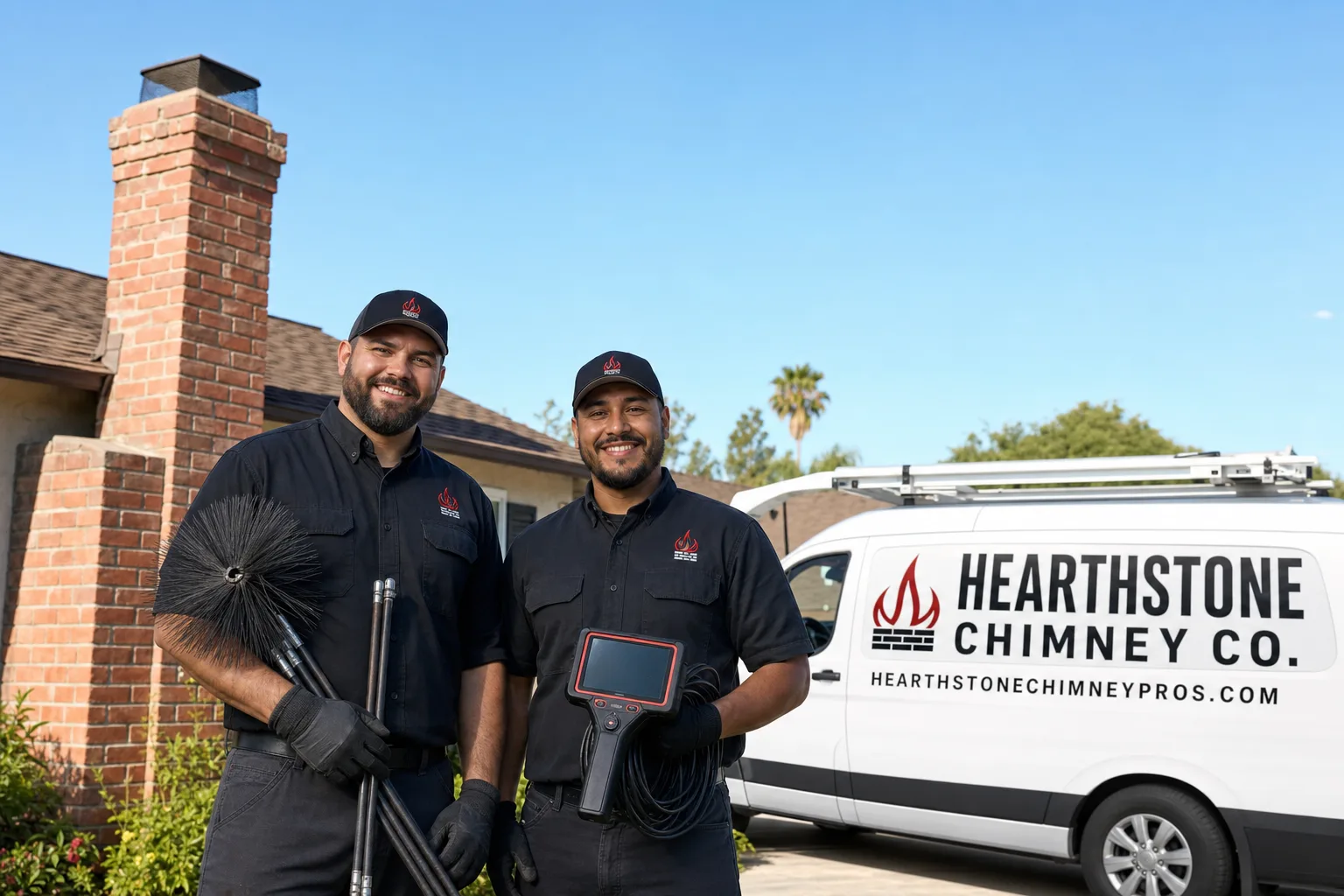
When your local Hearthstone Chimney Co. team arrives, the first step is always a Level-2 camera inspection – not a flashlight and a guess. The camera goes up the full length of the flue and comes back down with photos you can see on a screen and a plain-English verdict: what stage the creosote is at, whether the liner is intact, and what the repair path looks like. You get that verdict before anything else happens.
For stage one and early stage two buildup, a professional chimney cleaning and sweep resolves it in a single visit. For heavier stage two, rotary cleaning tools are brought in. Stage three glaze is treated with a chemical compound – often HeatShield – that either removes it or encapsulates it and restores the liner surface, depending on the liner’s condition. If the liner itself is damaged, a DuraFlex stainless steel liner relining gives you a smooth, correctly sized surface going forward.
Most jobs are completed in a single visit. The number on your written estimate is the number on your invoice – no surprises. And every job is backed by the 90-Day Done Right Promise: if it’s not right, we come back. In writing. No arguing.
Frequently Asked Questions
It cannot safely wait if you plan to use the fireplace again – full stop. Stage two and stage three creosote burns at temperatures that can exceed 2,000 degrees Fahrenheit, and a chimney fire at that temperature can crack the liner, ignite the surrounding structure, and travel into the walls of your home before you know it’s happening. Even if the buildup looks minor to you, you can’t determine the stage without a camera inspection. Call (844) 803-1545 and we’ll get someone out to assess it.
Call (844) 803-1545 right now – a live person answers every call, every hour, every day, and your local Hearthstone team will get you scheduled as quickly as possible. Most jobs are completed in a single visit, so you won’t be waiting on parts or a second appointment in most cases. The sooner you call, the sooner we can tell you exactly what you’re dealing with.
You likely can’t tell from the firebox opening, and that’s not a knock on your judgment – it’s just what the camera is for. Stage one looks dry and flaky; stage two is harder, crunchy, and darker; stage three is a dense, shiny, tar-like glaze that’s often baked into the tile surface. A Level-2 camera inspection gives you photos and a plain verdict, documented like an engineer, explained like a craftsman. That’s where every assessment starts.
It depends on the stage and the condition of the liner underneath. Stage one and two buildup are resolved with a professional sweep – no liner work needed in most cases. Stage three may require a chemical treatment like HeatShield, and if the liner itself is cracked or spalled, a stainless steel relining with DuraFlex is the permanent fix. Your written estimate will spell out exactly what’s needed and what it costs before any work begins. No guesswork, no upsells after the fact.
Get It Fixed
Call (844) 803-1545 – a live person answers right now, any hour of the day. Your local Hearthstone Chimney Co. team will schedule a Level-2 inspection, tell you exactly what’s there, and give you a written estimate before anything starts. Most jobs are done in a single visit.
Written by Russell Haines, Owner and Master Sweep at Hearthstone Chimney Co., serving local communities across the country since 1984.