
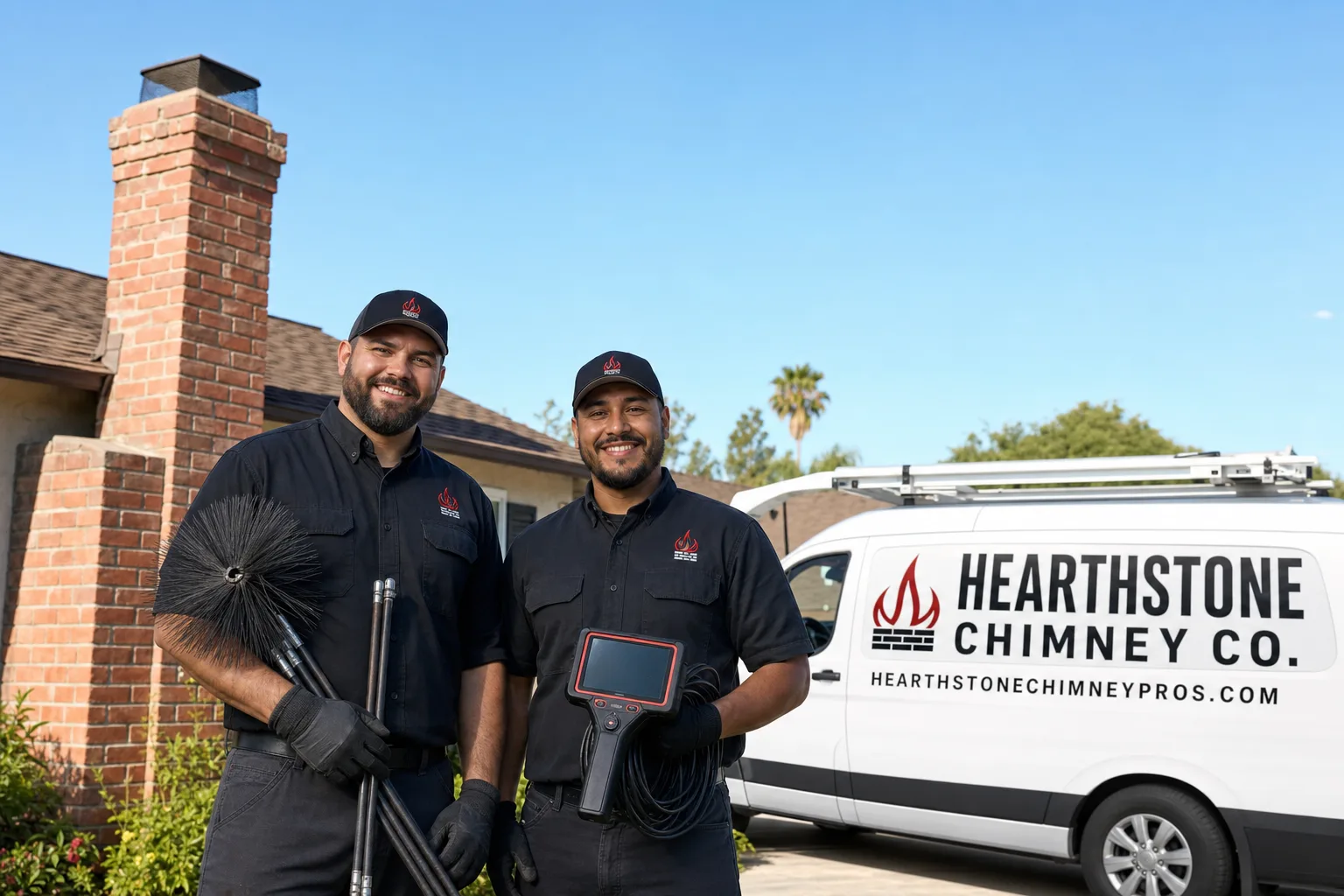
Chimney Liner Installation Cost in Los Angeles: What You’ll Actually Pay
Chimney Liner & Rebuild installation in Los Angeles typically runs $2,800-$6,500 for a standard single-story flue, with most homeowners landing near $3,800-$4,200 for a complete DuraFlex stainless flexible liner with proper insulation and top termination. Two-story flues add $800-$1,400, and hillside homes in Mount Washington or the Hollywood Hills can push toward $7,500 when equipment staging gets complicated. The only way to know your exact number is a Level-2 camera inspection - we credit that $289 inspection fee toward the liner work if you move forward. Call (844) 803-1545 and a live person will pick up, any hour.
Why the Liner Conversation in Los Angeles Starts With Earthquakes, Not Wear
Most chimney articles assume you’re replacing a liner that wore out from decades of wood fires. In our experience across Los Angeles, that’s rarely the case.
We get the call after a camera inspection reveals a 1920s Spanish Colonial chimney in Highland Park that was never lined at all - just bare brick, mortar joints open to the wall cavity. Or we find a 1930s Craftsman flue in Los Feliz where the clay tiles shifted laterally during the ’94 Northridge quake, got patched from the outside with stucco, and have been leaking combustion gases into the bedroom above ever since. The homeowner lit a gas log last December, smelled something off, and called us. The camera doesn’t lie.
Russell Haines, our owner, grew up in Eagle Rock a few miles from the Occidental College footbridge he used to cross on his bike as a kid. He’s spent the better part of two decades inspecting chimneys across the east side of Los Angeles, and he’ll tell you: the cruelest irony in this city is that Santa Ana winds in October and November make a fire feel appealing precisely when the South Coast Air Quality Management District is most likely to issue a No Burn curtailment. So the fireplace sits dormant for years, the homeowner never suspects a problem, and the cracked flue from a thirty-year-old tremor goes undetected until a gas conversion or a home sale inspection forces the issue.
That’s why our liner cost conversation always starts with a camera verdict, not a material quote. We don’t sell liners. We document what’s wrong, say it plainly, and fix it right.
The Two Liner Scenarios We See Constantly in L.A.
Not every liner job is the same, and in Los Angeles the split falls roughly into two camps. Understanding which one matches your chimney keeps you from getting a quote that’s useless.
Scenario One: Relining an Earthquake-Damaged Clay-Tile Flue
This is the Northridge legacy. A 1950s-1970s chimney in the San Fernando Valley or a pre-war brick stack in Pasadena has original clay flue tiles. The tiles cracked, shifted, or separated at the joints during seismic activity - sometimes the ’94 main shock, sometimes an aftershock, sometimes a more recent tremor you barely felt. The chimney still looks fine from the street. Inside, it’s a broken pathway.
We install a DuraFlex stainless flexible liner, properly sized to the appliance, with insulation wrap where required by code. The flexible design navigates the offsets and minor shifts that rigid liner can’t handle. Our technicians complete most of these in a single visit, though we won’t rush a job that needs a second day to be done right - and we stand behind it.
Typical range for this scenario:
| Scope | Cost Range |
|---|---|
| Single-story flue, straight run, standard access | $2,800-$3,800 |
| Single-story with offset or minor repair to smoke chamber | $3,400-$4,600 |
| Two-story flue or complex routing | $4,200-$5,800 |
| Hillside home with restricted equipment access (Mount Washington, Hollywood Hills) | $5,500-$7,500 |
Scenario Two: Lining a Previously Unlined Historic Brick Chimney for Gas
This is the 1920s-1940s story. Spanish Colonial Revival and Craftsman bungalows in Silver Lake, Highland Park, and Los Feliz were built with chimneys that have no liner whatsoever - no clay tiles, no metal, just brick and mortar exposed directly to combustion byproducts. It was standard construction then. It meets no standard now.
The twist: many of these homeowners converted to gas logs in the 1990s, thinking gas was safer and needed less infrastructure. Gas is cleaner, yes, but an oversized masonry flue venting a low-temperature gas appliance is a recipe for condensation, corrosion, and carbon monoxide spillage. The flue is too big, the draft is too weak, and the water vapor from combustion cools before it exits, eating the mortar from the inside.
These jobs require a properly sized liner - often a smaller diameter than the original flue - and sometimes a Chimney Liner & Rebuild in Los Angeles if the brick itself has deteriorated. We use DuraFlex for the liner core, with termination components from Olympia Chimney or Famco matched to your specific appliance and venting configuration. No builder-grade substitutes. The photos from our Level-2 inspection go in your file, dated, before we touch anything.
Typical range for this scenario:
| Scope | Cost Range |
|---|---|
| Single-story unlined flue, gas insert or log set, standard access | $3,200-$4,400 |
| Two-story unlined flue with sizing reduction required | $4,600-$6,200 |
| Smoke chamber parging + liner (common in pre-war chimneys) | $5,000-$6,800 |
| Exterior rebuild portion + new liner (earthquake-damaged brick) | $7,000-$12,000+ |
What Drives the Price Up or Down
We’ve given honest anchors above. Here’s what moves you within those ranges.
- Access. A chimney on a flat roof with a parapet wall is straightforward. A chimney on a pitched roof three stories up a hillside driveway in the Hollywood Hills requires scaffolding or a boom lift. That adds labor hours and sometimes a second day.
- Appliance type. Wood-burning requires a heavier-gauge liner and full insulation to handle higher temperatures and creosote. Gas runs cooler but demands precise sizing; an oversized liner for gas is almost as bad as none at all.
- Existing damage. Cracked flue tiles we can drop a liner past are one thing. A chimney that shifted on its foundation and needs structural stabilization before lining is another. The camera inspection catches this - that’s why we insist on it.
- Permit and inspection requirements. Los Angeles building codes require permits for liner installation in most cases, with a final inspection. We handle the paperwork, but permit fees vary by jurisdiction - L.A. City, Pasadena, and unincorporated county areas each have their own schedules.
- Material grade. We use DuraFlex stainless flexible liners, not the thin-wall imported substitutes some operators push. The difference in material cost is real, and the difference in lifespan is measured in decades. We also use HeatShield for smoke chamber parging where the existing brick needs sealing but not full rebuild.
The one thing that doesn’t change: our Affordable Chimney Liner & Rebuild in Los Angeles, CA with no-hassle upfront pricing. The number on the estimate is the number on the invoice. We’ve been answering the phone with a live person for over 12 years, and we plan to be here in thirty more. A square deal is how you stay in business that long.
Why the Camera Inspection Matters for Your Wallet
We charge $289 for a Level-2 camera inspection. If you proceed with liner installation, we credit that full amount against the job. If you don’t, you still have dated photos of your flue condition and a plain-English verdict you can use with any other contractor - or keep for your home file.
Here’s what that inspection prevents: a $3,500 liner quote that turns into a $7,000 surprise when the technician discovers the chimney shifted on its foundation and the flue is no longer plumb. Or a liner sized for wood-burning that rots out in five years because your gas appliance condenses water into an oversized flue. We’ve seen both. The camera finds what’s wrong before we say what it costs to fix.
Our technicians are background-checked and uniformed. They document every inspection like an engineer and explain it like a craftsman. Photos you can see, a plain-English verdict. That’s the standard.
Our 90-Day Done Right Promise
Every liner installation we perform is covered by our 90-Day Done Right Promise - the Keystone Standard - in writing with no arguing. If it’s not right, we come back. Krafted right, Every time, Your home first, Standing behind it. We’ve honored this promise since 1984, and we don’t intend to stop.
We also offer a permanent 5% Senior and Veteran discount, a $50 credit on any repair over $250, and free second opinions on any written estimate you’ve received elsewhere. No games. We’ll be there when we say.
FAQs
Most homeowners pay between $3,800 and $4,200 for a standard single-story DuraFlex stainless flexible liner installation, with two-story flues running $4,200-$5,800 and hillside access adding premium. See our How Much Does Chimney Liner & Rebuild Cost? (2026 Price Guide) - Los Angeles, CA for full details. The exact cost depends on your flue condition, appliance type, and access - which is why we require a Level-2 camera inspection first. Call (844) 803-1545 for a free estimate; the $289 inspection fee is credited toward liner work if you proceed.
Repairing individual clay flue tiles is rarely practical in Los Angeles because earthquake damage usually cracks multiple tiles and shifts joints throughout the flue; a Chimney Liner & Rebuild Near Me in Los Angeles, CA with a stainless flexible liner is almost always the more reliable and cost-effective solution long-term. Spot repairs on earthquake-compromised flues tend to fail at the next tremor, and they don’t address the underlying venting problem. We document the full flue condition with our camera so you can see exactly why we recommend replacement.
Yes - and in many Los Angeles homes with converted gas fireplaces, this is exactly the hidden problem. An unlined or oversized masonry flue venting gas appliances causes condensation, corrosion, and carbon monoxide risk because the flue is too large to maintain proper draft at low gas temperatures. The South Coast Air Quality Management District’s wood-burning restrictions have pushed many Valley homeowners to gas without updating their venting; a properly sized liner is a safety correction, not an upgrade. Our inspection will measure your flue and appliance output to specify the right diameter.
Sometimes, but we won’t promise it until we’ve seen the flue. Straight single-story runs with good access and no surprises can often be completed in one visit if we arrive prepared with the right diameter liner. Two-story jobs, hillside access, or chimneys needing smoke chamber repair typically schedule a second day. We’d rather do it right than do it fast - and our 90-Day Done Right Promise means we’re coming back for free if we rush and miss something. Call (844) 803-1545 to schedule; a live person answers 24 hours a day.
Ready to Know What Your Chimney Actually Needs?
Don’t guess at a liner quote based on square footage or neighborhood averages. Get the camera inspection, see the photos, and know your real cost before anyone touches a tool. We’ve served Los Angeles communities for over 12 years, and we’re not going anywhere. Call (844) 803-1545 - a live person will answer, any hour - or schedule your Level-2 inspection online. Estimates are free, the inspection fee credits toward work, and the number we quote is the number you pay.
Written by Russell Haines, Owner & Master Sweep, Hearthstone Chimney Co. at Hearthstone Chimney Co., serving Los Angeles, CA.
What Our Customers Say
"The fireplace had never drawn properly since we moved in. He found the damper was only opening halfway on a bent linkage and fixed it in ten minutes."
- Tim Kowalski"Second property I have had them at. Both times the tech showed me photos from inside the flue before quoting anything."
- Ryan Hoffman"The cap keeps the birds out now, which after two springs of scratching noises above the bedroom is worth every penny."
- Nisha Gupta