
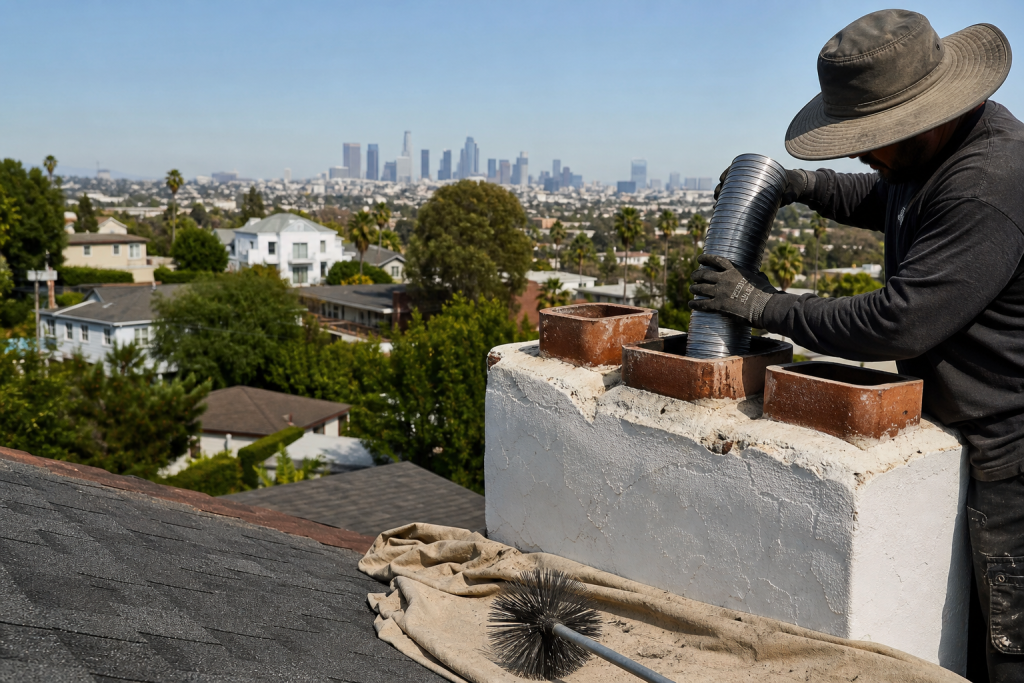
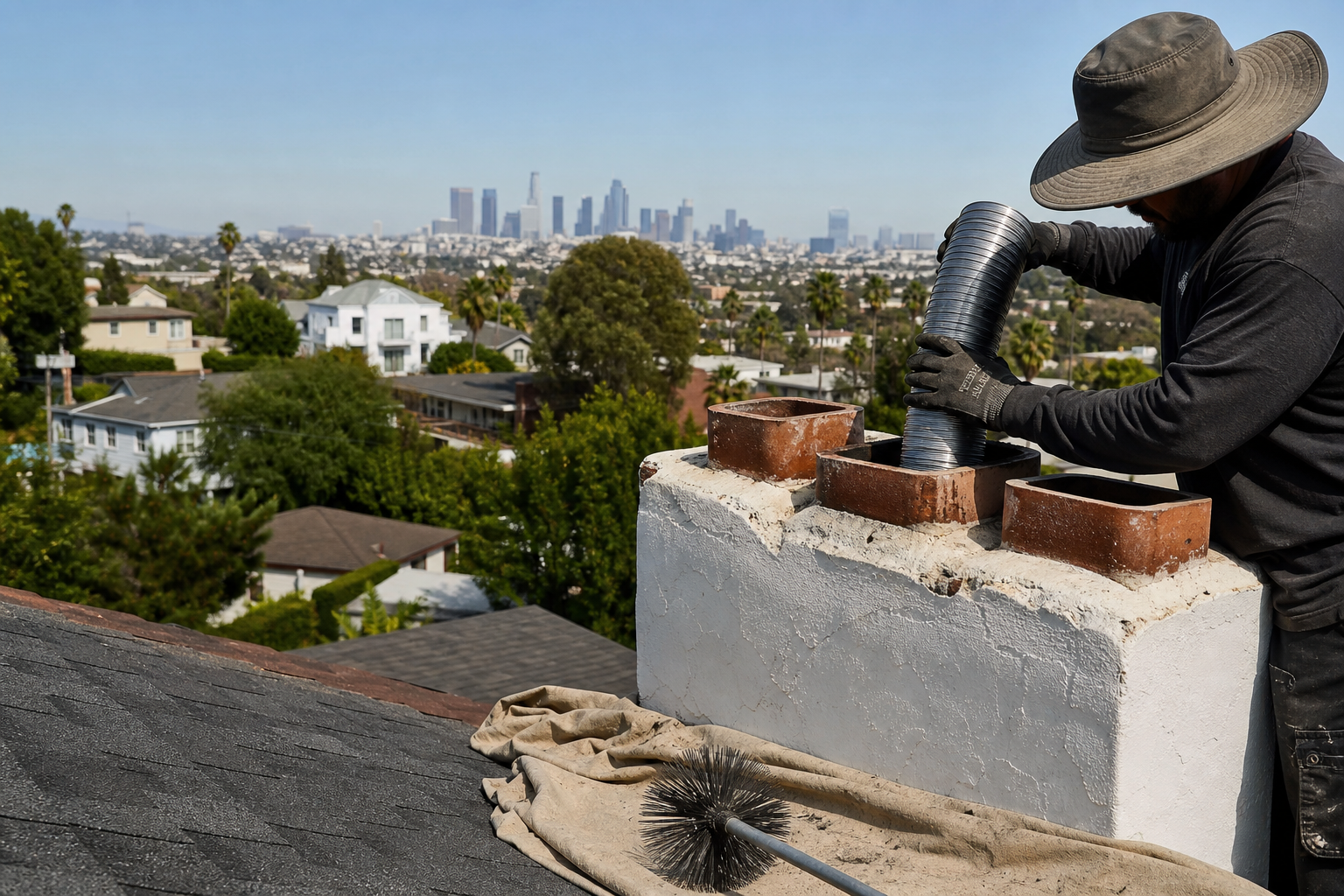
Chimney Liner & Rebuild: Repair or Replace? How Los Angeles Homeowners Decide
Most chimney liners in Los Angeles fail in one of three ways: surface spalling, joint separation, or full structural collapse. The repair-or-rebuild decision depends entirely on which failure mode is present, and that answer only comes from a Level-2 camera inspection, not a flashlight-and-mirror guess from the firebox. If you’d rather not climb on your roof or interpret flue footage yourself, call (844) 803-1545 and we’ll document exactly what you’ve got.
Here’s the mistake we see weekly: a homeowner in Silver Lake or the Valley gets told their liner is “cracked” and needs a full rebuild for $4,000-$7,000. What the technician actually saw was surface spalling, thin flakes of clay coming off the liner wall, which a HeatShield resurfacing fixes for a fraction of that cost. The difference between a $1,200 repair and a $6,000 rebuild is about twelve feet of camera cable and someone who knows what they’re looking at.
The Three Ways Chimney Liners Fail (and Why Each Needs a Different Fix)
Clay tile liners, which vent most Los Angeles fireplaces built before 1990, do not fail randomly. They fail in predictable patterns based on what stressed them.
Surface spalling happens when moisture and acidic flue gases eat the inner face of the clay tile. The surface gets rough, flakes off, and creates pockets that catch creosote. The tile itself is still structurally sound. We’ve resurfaced dozens of these in Hancock Park and Mid-Wilshire with HeatShield, a cerfractory flue sealant that restores a smooth, gas-tight surface. The job takes a day, the liner is usable that evening, and the cost runs roughly $1,000-$2,500 depending on flue height and access.
Joint separation is more serious. Clay tiles stack with a thin mortar joint between them. When that joint gaps, cracks, or falls out, exhaust gases leak into the chimney cavity. You cannot seal this from the inside with any coating. The tiles must be removed and replaced, or a stainless steel liner must be dropped inside the existing flue. In Los Angeles, where many chimneys vent through stucco walls with limited lateral access, dropping a flexible DuraFlex liner is often the only practical path. Expect $2,800-$5,500 for a typical two-story home.
Full structural collapse means tiles have fallen, shifted, or blocked the flue. This is an immediate fire and carbon monoxide hazard. The chimney is not usable until rebuilt. We see this most often in pre-1940s Los Angeles homes with original liners that survived the 1971 Sylmar quake or the 1994 Northridge quake with hidden damage that worsened over decades. Rebuild scope includes full liner removal, structural assessment of the surrounding masonry, precise diameter calculation for the replacement system, and post-installation camera verification. Costs range $4,500-$8,500 in most LA neighborhoods.
The critical point: only a camera inspection distinguishes these three conditions with certainty. A technician estimating from the firebox opening is guessing, and guesses in this business tend to favor the most expensive option.
Why Surface Spalling Gets Misdiagnosed (and Costs You Thousands)
Last month we were in a garage in Los Feliz where a homeowner had been quoted $5,200 for a “complete liner rebuild.” The previous company never ran a camera. They shined a flashlight up from the firebox, saw roughness on the lower tile face, and wrote up the worst-case scenario. Our Level-2 inspection showed joint integrity was perfect for the full 18-foot run. We resurfaced with HeatShield for $1,850. The homeowner lit their first fire three days later.
This happens because surface spalling and joint failure can look similar from below. Both show as irregular, darkened surfaces. But a camera at the joint level reveals the truth: spalling is shallow erosion, joint failure is a gap you could slide a coin into. Without that footage, you’re buying a diagnosis made in bad light at a bad angle.
We document every chimney repair in Los Angeles with photos the homeowner can see and a plain-English verdict. No engineer speak, no scare tactics. Just: here’s what we found, here’s what it means, here’s what we’d do if it were our house.
When Resurfacing Is Right, and When It Hides a Bigger Problem
HeatShield and similar cerfractory resurfacers are excellent products when applied to the right substrate. They are not magic. They will not bridge a separated joint. They will not hold on a liner that has shifted out of plumb. They will not compensate for a flue that is incorrectly sized for the appliance it vents.
We recommend resurfacing when:
- The clay tiles are intact with no joint gaps visible on camera
- The flue diameter matches the appliance’s listed requirements
- The chimney has adequate height and draft for the fuel type
- There is no evidence of previous hidden fire damage in the surrounding masonry
We recommend against resurfacing when:
- Any joint shows separation exceeding 1/8 inch
- Tiles are out of alignment or have visible cracks through their body
- The liner was previously resurfaced and is failing again
- The chimney vents a gas insert that was installed in a wood-burning flue without proper sizing verification
That last point matters enormously in Los Angeles, and most chimney companies won’t bring it up.
The LA Gas Conversion Problem Nobody Talks About
Between the 1960s and 1990s, Southern California Gas Company pushed hard to convert wood-burning fireplaces to gas logs and inserts. Thousands of Los Angeles homeowners took the deal. What rarely happened: proper liner resizing.
A wood fire needs a large flue to develop adequate draft at low gas velocity. A gas appliance needs a smaller flue to maintain sufficient velocity to carry moisture and combustion products up and out. When you vent a 40,000 BTU gas insert through a liner sized for an open wood fire, the gases move too slowly. They cool, condense, and produce acidic moisture that destroys the liner from the inside. We’ve pulled failed liners in Pasadena, Altadena, and Studio City where the root cause was not age or earthquake damage, but fifteen years of wrong-size venting.
This is a safety issue before it’s an efficiency issue. Slow gases mean carbon monoxide can spill into the home under certain weather conditions. If your Los Angeles home has a gas insert in an original wood-burning chimney, the liner diameter needs verification against the appliance’s installation manual. Not the original 1950s specs. The insert’s specs. We do this calculation on every inspection where gas venting is present.
What a Legitimate Liner Rebuild Includes (and What to Demand in Writing)
If your chimney needs a full liner rebuild, the scope of work should be specific enough that another technician could bid against it without re-inspecting. Vague proposals are a red flag.
Demand these elements in writing:
- Liner diameter calculation based on the appliance’s BTU input, fuel type, and total vent height, not a guess based on “what was there before.”
- Material specification: clay tile (rare in modern rebuilds due to seismic concerns), rigid stainless steel of stated gauge, or flexible stainless steel with alloy grade noted. We typically specify DuraFlex or Olympia Chimney flexible liners in 316Ti stainless for Los Angeles conditions.
- Insulation requirement if the flue passes through an exterior wall or unconditioned space, which is common in hillside Los Angeles construction.
- Post-installation camera verification showing the full liner run, all connections, and the termination cap. This is your proof the job was done right.
- Written guarantee with clear terms, not a verbal “we stand behind our work.”
Our 90-Day Done Right Promise covers every liner rebuild we do in Los Angeles: if it’s not right, we make it right, in writing, no arguing. We’ve honored it three times in forty-two years. We’d rather eat the cost of a callback than eat the reputation damage of a bad job.
Most of our liner rebuilds are completed in a single visit by background-checked, uniformed technicians. The number on your estimate is the number on your invoice. No surprises on the bill.
What happens when you call
- 1
A real person answersNo phone trees - you reach a local pro.
- 2
You get an upfront price rangeHonest numbers before anyone is dispatched.
- 3
A background-checked tech heads outLicensed & insured, dispatched right away.
- 4
You approve before work beginsNothing starts until you say go.
Using Liner Condition as Leverage When Buying a Los Angeles Home
A failed chimney liner is not a vague “needs work” item to accept or negotiate around blindly. It is a documented defect with a known remediation cost, and in Los Angeles’s competitive market, buyers who understand this gain leverage.
Here’s how to use it: during inspection contingency, hire a Level-2 camera inspection specialist, not a general home inspector with a flashlight. Get footage. Get a written repair-or-rebuild estimate. If the liner needs $4,500 in work, that’s a credit or price reduction with a specific number attached, not a $10,000 “chimney allowance” that pads the seller’s position.
We provide second opinions on any written estimate for free. Bring us another company’s scope and numbers. We’ll tell you if they’re accurate, inflated, or incomplete. No charge, no pressure. We’ve done this for buyers in Brentwood, Eagle Rock, and Van Nuys who needed an honest read before closing.
Related: if you’re maintaining a home you already own, our Chimney Cleaning & Sweep in Los Angeles includes basic liner condition assessment during the standard sweep. Catching spalling early means resurfacing instead of rebuilding.
When to Call a Pro
Call before you smell smoke where it doesn’t belong, before your carbon monoxide detector chirps, and certainly before you sign off on a home purchase with an uninspected chimney. In Los Angeles, where we burn fewer fires than colder cities but burn them in older systems, deferred maintenance compounds faster than people expect.
If your chimney is original to a pre-1990 home and has never had a camera inspection, you’re flying blind. The call costs nothing. The information changes everything.
We also handle Fireplace Services in Los Angeles including gas insert sizing verification, which pairs directly with liner assessment.
The Bottom Line
The repair-or-rebuild decision is not a judgment call made from a firebox. It is a data-driven conclusion drawn from camera footage, interpreted by someone who can distinguish surface spalling from joint separation from collapse, and who will tell you the truth even when the cheaper option costs them a larger sale.
Key takeaways for Los Angeles homeowners:
- Surface spalling = resurfacing, typically $1,000-$2,500
- Joint separation or misalignment = liner replacement, typically $2,800-$5,500
- Structural collapse = full rebuild, typically $4,500-$8,500
- Gas inserts in original wood flues need diameter verification against appliance specs, not chimney age
- Always demand post-installation camera proof and a written guarantee
If you’re in Los Angeles and facing this decision, Hearthstone Chimney Co. offers free estimates with Level-2 camera inspection, photos you can see, and a plain-English verdict. Call (844) 803-1545. A live person answers, 24 hours a day, every day. We’ll be there when we say. Done right, and we stand behind it.
Frequently Asked Questions
Surface resurfacing with HeatShield typically runs $1,000-$2,500 for a standard two-story Los Angeles home. Full stainless steel liner replacement runs $2,800-$5,500. Complete rebuild after structural collapse ranges $4,500-$8,500. The only way to know which applies is a Level-2 camera inspection. Call (844) 803-1545 for a free estimate with exact pricing for your chimney.
Repair is cheaper when the clay tiles are structurally sound with intact joints. Resurfacing costs roughly one-third to one-half of full replacement. But applying resurfacer to a liner with joint separation or hidden fire damage wastes money and creates a false sense of safety. We see this mistake most often in Los Angeles homes where a previous owner deferred proper inspection. Get camera footage first, then decide. Estimates are free at (844) 803-1545.
Yes. Joint separation and structural collapse allow exhaust gases, including carbon monoxide, to leak into wall cavities and living spaces. In Los Angeles, where many homes have gas inserts venting through aging liners, wrong-size flues compound the risk by producing acidic condensation that accelerates deterioration. Any suspected liner damage should be camera-inspected before the next fire. Call (844) 803-1545 to schedule.
Check the appliance’s installation manual for the required liner diameter and compare it to your actual flue dimensions. Most gas inserts require a 6-inch or smaller liner; original wood-burning flues are often 8 inches or larger. If the insert was installed without resizing verification, assume it’s wrong until proven otherwise. We verify this pairing on every inspection in Los Angeles. Call (844) 803-1545 for a free second opinion on any previous estimate.
Written by the team at Hearthstone Chimney Co., serving Los Angeles since 2014.
Need Chimney Cleaning Help?
Call Hearthstone Chimney Co. - licensed & insured, here with fast after-hours help in Los Angeles.
(844) 803-1545